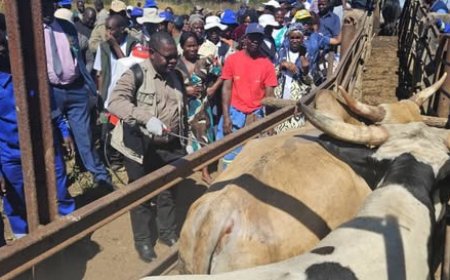
GABORONE, Botswana — The Botswana Vaccine Institute (BVI), Africa's leading veterinary vaccine manufacturer and a World Organisation for Animal Health (WOAH) Reference Laboratory since 1985, has activated its crisis response mechanisms following an escalation of Foot and Mouth Disease (FMD) outbreaks across the Southern African Development Community (SADC) region (p. 1). The institute is deploying technical missions to affected member states, including a recent mission to Eswatini, to facilitate targeted disease containment strategies.
The current FMD situation has been described as South Africa's worst outbreak in history, with the SAT2 serotype dominating and transmission pressure considered "exceedingly high" across seven provinces. Zimbabwe has also confirmed SAT1 serotype outbreaks in the Matabeleland South Province, linked to wildlife-livestock interface transmission dynamics. The FMD virus, a highly contagious picornavirus, spreads rapidly through direct contact, contaminated materials, and aerosol transmission, with an incubation period of 2 to 14 days complicating early containment efforts.
Technical Missions and Strain Identification
BVI's response prioritizes a scientifically informed approach to vaccination. The technical missions, led by veterinary epidemiologists such as Dr. Tshenolo Pebe in Eswatini, are tasked with collecting samples from outbreak zones to identify the specific circulating virus strains. This strain identification is a critical step in preventing misdirected vaccination efforts, as protection against one serotype does not confer immunity against another.
The BVI laboratory, a BSL-3 capable facility with ISO accreditation, performs a suite of molecular and serological diagnostics, including virus isolation (VI), PCR, and ELISA, to characterize the FMD virus (FMDV). The findings inform the formulation of fit-for-purpose vaccines for emergency deployment (p. 1). BVI maintains a capacity to supply up to 1 million doses per month for accelerated vaccination programs in high-risk zones.
Disease Control Measures and Industrial Impact
The escalating FMD situation necessitates strict adherence to established control measures, including mandatory livestock movement restrictions, quarantine protocols, and enhanced biosecurity (p. 1). Authorities require high-quality, high-potency vaccines, often trivalent (SAT 1, 2, and 3), to achieve adequate coverage of susceptible animal populations. The virus is sensitive to high or low pH, sunlight, and high temperatures but remains viable in the environment for extended periods, necessitating robust disinfection protocols.
The outbreak has resulted in substantial economic costs and trade restrictions. Several key export markets, including those in the European Union (EU), have historically imposed import bans on beef products from FMD-vaccinated areas unless purified, DIVA (Differentiating Infected from Vaccinated Animals)-type vaccines are used. BVI's high-tech lab is capable of producing these purified vaccines, a capability essential for maintaining market access.
BVI emphasizes that effective mitigation of the current outbreak and the promotion of sustainable animal health systems depend on continued collaboration and technical rigor among SADC member states
Foot-and-mouth disease (FMD) is caused by a highly diverse RNA virus that exists as seven distinct immunological serotypes: O, A, C, Asia 1, SAT 1, SAT 2, and SAT 3. The critical technical challenge is that infection with one serotype does not confer immunity against another.
Technical Differences of Serotypes
|
Serotype
|
Global Distribution
|
Key Characteristics & Stability
|
|
O
|
Global; Causes over 60% of outbreaks worldwide.
|
Moderately thermostable. Frequently circulates in East Africa and the Middle East/Asia.
|
|
A
|
Global; Highly diverse both antigenically and genetically.
|
Exhibits varied stability; some non-African strains are very stable, while East African strains can be less stable.
|
|
C
|
Historically global, but has not been detected since 2004.
|
Effectively considered extinct in circulation.
|
|
Asia 1
|
Primarily restricted to Asia and the Middle East.
|
Not typically found in the SADC region.
|
|
SAT 1
|
Exclusively African (Southern African Territories).
|
Lower thermostability compared to O or A types; naturally hosted by African buffalo.
|
|
SAT 2
|
Exclusively African; The most predominant serotype in recent SADC outbreaks (e.g., South Africa's 2025/2026 crisis).
|
Lower thermostability; also has a wildlife reservoir in African buffalo.
|
|
SAT 3
|
Exclusively African; restricted to Southern and parts of Eastern Africa.
|
Lower thermostability; naturally hosted by African buffalo.
|
Significance in the SADC Context
The significance of these differences in the SADC region, where five of the seven serotypes (O, A, SAT 1, SAT 2, SAT 3) circulate, is critical for successful disease control.
1. Requirement for Serotype-Specific Vaccines
The lack of cross-protection means that a vaccine must precisely match the circulating serotype in the field. Using a Type O vaccine during a SAT 2 outbreak would be entirely ineffective. Within serotypes, there are also many strains (topotypes and lineages), and vaccines must be matched to these as well, using "r1-values" to assess antigenic relationship.
2. The Role of the African Buffalo Reservoir
The SAT serotypes are maintained in wild African buffalo populations, which act as a constant source of spillover infection into domestic livestock at the wildlife-livestock interface (e.g., near the Kruger National Park in South Africa). The Botswana Vaccine Institute (BVI) focuses heavily on these SAT types in its standard trivalent (SAT 1, 2, 3) or polyvalent vaccines to manage this specific regional challenge.
3. Trade and DIVA Principle
The type of vaccine used dictates a country's ability to export meat products. BVI produces highly purified vaccines (AFTOVAXPUR) that allow veterinary services to differentiate between an infected animal and a vaccinated animal using specific diagnostic tests (the DIVA principle). This capability is crucial for countries like Botswana and South Africa to regain or maintain valuable FMD-free status and access international export markets.
4. The "Antigenic Arms Race"
The FMD virus is an RNA virus that mutates frequently, leading to new variants that can escape existing immunity. This necessitates continuous monitoring and vaccine matching studies, which is why BVI deploys technical teams to outbreaks to constantly update their antigen bank and vaccine formulations

 Francis