From Highway to Hard Drive: Zimbabwe's Project Pros Mandated to Master AI and Cyber Resilience
 Francis

The blueprint for Zimbabwe's next phase of national development will be written in code as much as concrete. At the 2025 Project Management Symposium, Hon. Professor Paul Mavima, Minister of Skills Audit and Development, issued a clear mandate to the nation's project management corps: future-proof your skills for a digital era defined by artificial intelligence and cyber threats.
By Francis S. Bingandadi Editor FinTech Review.Africa
This call to action moves beyond theoretical discussion, positioning technological mastery as a non-negotiable requirement for executing the forthcoming National Development Strategy 2 (NDS 2). The Minister's directive reflects a global trend, evidenced by industry events like the recent Project & Contract Management Summit in Victoria Falls, which focused exclusively on "the transformative role of AI, cybersecurity, and data protection".
The AI Imperative in National Project Portfolios
Minister Mavima was explicit about the tools required for modern governance. "It is imperative that we integrate Artificial Intelligence, predictive analytics, and digital governance tools to strengthen planning, enhance accuracy, and elevate project monitoring and control," he stated.
This aligns with cutting-edge industry exploration into AI-driven tools for planning, predictive analytics, and using Natural Language Processing (NLP) to automate complex contract analysis. For a national portfolio spanning massive infrastructure, digital transformation, and climate-resilient projects, leveraging AI for data-driven decision-making is now considered a strategic advantage.
Cybersecurity: The New Bedrock of Project Integrity
With great digitalization comes great risk. The Minister warned that as projects become more digitized, the threat landscape widens, making strong cybersecurity frameworks essential from project inception to closure. This concern is paramount across sectors, with industry summits dedicating significant agenda space to best practices for safeguarding project data and frameworks for assessing cyber threats.
"For Zimbabwe to compete and excel," Professor Mavima argued, "we must prioritise the development and strengthening of Project Management Offices (PMOs) across Government and industry." He envisions these PMOs evolving into strategic hubs that not only ensure alignment and efficiency but also act as guardians of data integrity and cyber-resilient practices.
Bridging the Skills Gap: A National Priority
The ambitious digital transformation of project delivery hinges on a parallel investment in human capital. The Minister's own portfolio—Skills Audit and Development—is central to this challenge. He called for an expansion of "mentorship pathways so that experienced professionals can groom emerging leaders".
This need is acutely felt in niche areas like the integration of AI and cybersecurity, where specialized knowledge is critical. The proposed partnership with the PMI Zimbabwe Chapter aims to co-develop training and standards that build this essential national skills pipeline, ensuring the workforce can operationalize the high-tech vision for NDS 2.
A Future Built on Discipline and Data
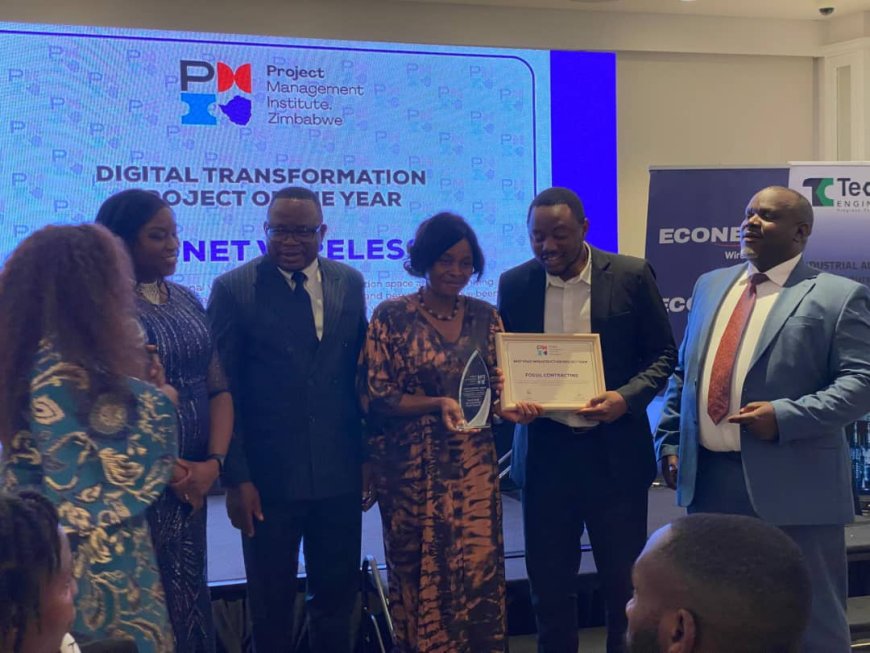
In his closing remarks, Professor Mavima connected the ethos of the profession to the tools of the future. "Your work demonstrates that excellence is not an aspiration, but a discipline," he told the award-winning project managers. That discipline must now encompass the diligent application of AI and rigorous cyber hygiene.
As Zimbabwe charts its course toward an empowered, prosperous upper-middle-income society by 2030, its progress will be measured not only in kilometers of road built or megawatts generated but in the sophistication of the digital systems that planned, secured, and delivered them. The project management profession has been handed the dual mandate to build the nation and digitally fortify the process.







![8 ways Samsung is using AI [Case Study] [2026]](https://fintechreview.africa/uploads/images/202601/image_430x256_696b430dca7f3.jpg)