The Digital Backbone: How 5G, AI and Cloud Are Reshaping Zimbabwe’s Industry
 Francis

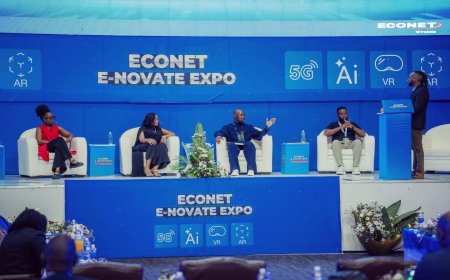
A critical shift is underway in Zimbabwe’s economic infrastructure, moving beyond connectivity to intelligent integration. At a recent industry forum, senior technologists from the nation’s leading telecom and industrial sectors outlined a clear vision: the strategic convergence of 5G, IoT, Cloud, and AI is no longer experimental but is becoming the essential backbone for national competitiveness and value chain transformation.
By Francis S. Bingandadi FintechReview.africa Editor
Moderated by award-winning journalist Farai Mwakutuya, the panel brought together executives driving this integration. A unified message emerged: deploying these technologies in isolated silos yields limited returns, but their orchestrated fusion creates a powerful engine for efficiency, security, and new business models.
5G: The Conduit for Industrial Transformation
The discussion positioned 5G not as a consumer luxury but as critical industrial infrastructure. Matthew Masiyazi, a strategist at Econet Wireless, emphasized its role as the "central nervous system" for modern enterprise. "We are moving beyond theoretical speed tests," he stated. "The focus is on providing ultra-reliable, low-latency connectivity that serves as the mandatory pipeline for real-time data from sensors, machines, and remote operations."
This view was echoed on the front lines of heavy industry. Percy Sibanda, Group ICT Manager at mining giant Zimplats, detailed tangible applications. "In a multi-mine operation, 5G enables the real-time telemetry of hundreds of pieces of equipment," he explained. "We are talking about predictive maintenance alerts, real-time fuel and performance optimisation for haulage trucks, and enhanced safety monitoring in hazardous areas—all requiring the robust, wide-area network that 5G provides."
AI and IoT: The Brain and Senses of the Value Chain
While 5G provides the conduit, IoT and AI form the sensory and cognitive layers. Maria Chinomwe, General Manager for Technology Services at Econet, framed data as the new primary resource. "IoT sensors deployed across agriculture, mining, and logistics create a constant data stream," she said. "But raw data is just noise. AI is the tool that translates this into actionable intelligence—predicting crop yields, optimising mineral extraction, or streamlining supply routes."
Sibanda provided a concrete example from Zimplats: "By applying AI analytics to IoT data from our concentrator plants, we can now predict process inefficiencies hours before they cause a drop in metal recovery. This moves us from reactive repair to proactive optimisation, safeguarding both output and margin."
The Non-Negotiable Foundation: Cybersecurity and Cloud
As value chains digitize, their attack surface expands. Joseph Magweregwede, an AI and cybersecurity strategist, issued a stern warning. "Integrating 5G, IoT, and AI without designing security from the silicon up is building a critical national asset on a foundation of sand," he argued. "A single compromised sensor in a smart farm or mining grid can feed corrupted data to an AI, leading to catastrophic operational or financial decisions. Security cannot be bolted on later."
The panel agreed that a sophisticated, zero-trust security model must be inherent in these systems. Magweregwede highlighted the dual role of AI, noting it is both a target for attack and a potent defence tool capable of detecting anomalous network behaviour in real-time.
This vast ecosystem of data and intelligence necessitates a new approach to compute. The consensus pointed to hybrid cloud as the essential model. "The scale and complexity of processing this data make on-premise-only infrastructure untenable," said Chinomwe. "The cloud provides the elastic compute power for AI training and large-scale analytics, while sensitive, real-time operational data can be processed at the edge—on-site or via local data centers. This hybrid model is key for sovereignty, speed, and cost-control."
Strategic Imperatives for National Scale
The panel concluded that unlocking value at a national scale requires deliberate strategy beyond corporate investment:
-
Policy and Spectrum Alignment: Masiyazi stressed the need for forward-looking regulatory frameworks. "Affordable, dedicated spectrum for enterprise 5G use cases is crucial for industries to invest confidently. Policymakers must treat industrial 5G as a productivity tool, not just a revenue source."
-
Skills as Critical Infrastructure: Magweregwede and Chinomwe identified a severe talent gap. "We need a national effort to build skills in data science, AI ethics, IoT engineering, and cybersecurity," Chinomwe urged. "This is now as critical as building roads or power stations."
-
Cross-Sector Collaboration: Success hinges on collaboration between telecom providers, technology vendors, industrial firms, and academia to co-develop solutions for Zimbabwean challenges, from agricultural supply chains to mineral beneficiation.
"Ultimately," moderator Farai Mwakutuya summarized, "this is about building Zimbabwe's digital muscle memory. It’s a coordinated push to embed intelligence into our primary sectors, making them leaner, smarter, and more competitive on a global stage. The tools are here; the task now is integration at speed and scale."
The forum made it clear that for Zimbabwe, the integrated deployment of 5G, IoT, Cloud, and AI is a strategic imperative for value chain transformation. The journey from raw material to finished product, from farm to market, is being re-engineered in real-time, with digital technology at its core.