NSSA Warns That Poor Planning Kills Workers, Demands Relentless Hira and Worker-Centred Design
 Francis
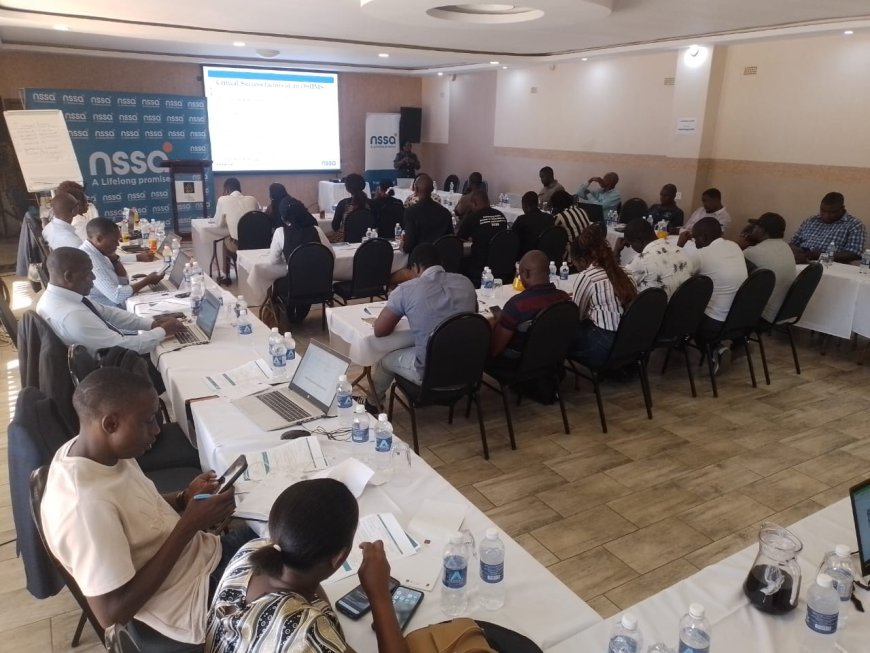
GWERU — The National Social Security Authority (NSSA) has urged employers to adopt Occupational Safety and Health Management Systems (OSHMS) to ensure effective make-or-break point for workplace safety, demanding continuous hazard identification, legally binding targets, and work environments designed around human beings — not machines.
Mrs. Thembekile Dumbu, Principal OSH Promotion Officer at NSSA, gave a detailed breakdown of OSHMS Requirements during the Journalists Basic Occupational Safety and Health Course (BOSHC) at The Village Lodge and said that planning is the critical phase where an OSHMS either prevents accidents or collapses entirely.
“Establish and implement processes for hazard identification and risk assessment (HIRA) and control on an ongoing basis,” the presentation slide stated. Dumbu stressed that “ongoing” means HIRA is not a once-off audit conducted just before NSSA inspectors arrive. Instead, it must be updated after every workplace incident, the installation of any new machine, or any change in operational process.
She then explained that companies must “set objectives and targets linked to the hazards and risk as well as the aspects of your organisation.” Dumbu offered a concrete example: if silica dust is the identified hazard, the target must be measurable dust levels below legal limits — not vague promises like “improve safety awareness.” Without measurable targets, she argued, there is no accountability.
“Clearly defining and understanding work activities and hazards arising from work activities” is non-negotiable, Dumbu said. She explained that job safety analyses must list each task step alongside the specific hazard per step. “Grinding is not the hazard. Flying metal fragments hitting the eye is the hazard,” she told the journalists.
The slide then listed “potential emergency situations.” Dumbu clarified that this covers fires, chemical spills, mine collapses, and power failures. Companies must plan emergency response procedures, evacuation routes, and first-aid arrangements before any incident occurs — not after bodies are recovered from the rubble.
Mrs. Dumbu said that “design of work areas, machinery, operating procedures and adaptation of work to the needs and capabilities of workers.” Dumbu gave stark examples: adjustable workbenches, machine guards designed for shorter workers, and safety procedures written in languages that all staff can understand. “If you force a 1.5-metre-tall worker to operate a machine designed for a 1.8-metre-tall person, you have designed the accident,” she warned.
Legal compliance is critical to “Determine applicable, and compliance with legal and other requirements.” Dumbu said this compels companies to actively track the Pneumoconiosis Act, the Factories and Works Act, Statutory Instrument 68 of 1990, and sector-specific regulations. Ignorance of the law, she stated, is not an excuse but a system failure.
Companies must also demonstrate an “understanding of National OSH Policy requirements.” Dumbu noted that Zimbabwe’s 2021 National OSH Policy commits the nation to Vision Zero and requires firms to align their internal safety objectives with that national target of zero deaths and zero serious injuries — no exceptions.
Zimbabwe recorded 57 worker deaths and 8,371 injuries in 2024-2025, a decline from 75 deaths and 8,770 injuries in 2022-2023. The Injury Frequency Rate improved from 2.3 to 2.1. She attributed that drop directly to firms that maintained documented HIRA registers and measurable.
Globally, the International Labour Organization (ILO) reports that 2.7 million workers die each year from occupational accidents and diseases. Dumbu argued that the vast majority of those deaths trace back to planning failures: no HIRA, no measurable targets, no emergency plans, or workplaces designed for machines instead of human beings.
To empower journalists as watchdogs, Dumbu provided a practical checklist: “Ask for the HIRA register. Is it dated this quarter? Ask for objectives. Are they tied to the top three hazards? Ask for the legal register. Is the Pneumoconiosis Act listed? Ask for emergency plans.